What Activated Carbon Can and Cannot Do
Why carbon belongs in the conversation about gases and odors, and why the amount, design and evidence still matter.

Activated carbon can adsorb certain gases and odor-causing compounds as air passes over its surface. It does not capture every gas equally, and a carbon-backed HVAC filter is not the same as a large dedicated gas-removal system. Real-world effectiveness depends on the target pollutant, carbon quantity, media design, contact time, airflow and replacement condition.
MERV rates particles; carbon is used for certain gases and odors.
A linked method behind any quantified carbon-performance claim.
Address hazardous or persistent sources instead of relying on a filter.
Particles and gases are different problems
Dust, pollen and other airborne particles are physical matter. Odors and volatile organic compounds are gases. A particle filter and a gas-phase material therefore do different jobs. MERV describes particle-filtration performance; it does not rate gas or odor removal. Activated carbon is a porous sorbent used in some products for certain gases. Pairing particle media with carbon can give one filter two kinds of media, but it does not make either job unlimited. The construction should be described accurately so buyers know what each layer is intended to address.
Adsorption is not a universal eraser
Activated carbon works through adsorption: some molecules adhere to its large internal surface. Whether that happens effectively depends on the molecule and the conditions. Carbon may help with some odor-causing compounds while doing little for others. It cannot correct the source of smoke, a fuel leak, water damage or microbial growth. It should never be used as a reason to ignore a hazardous condition. If an odor is persistent, sudden or associated with combustion, chemicals or moisture, identify and address the source rather than trying to cover the signal with filtration.
Amount and contact time matter
EPA consumer guidance notes that activated carbon can be effective for gases when a large amount of material is used. That limitation is important when evaluating a thin carbon-backed residential HVAC filter. More substantial sorbent media can provide more capacity, while a light layer may have a narrower or shorter-lived effect. Airflow and contact time matter as well. Without product-specific test data, no responsible brand should translate the mere presence of carbon into a percentage-removal claim or a promise covering every odor or VOC.
What TRU’s carbon backing is designed to do
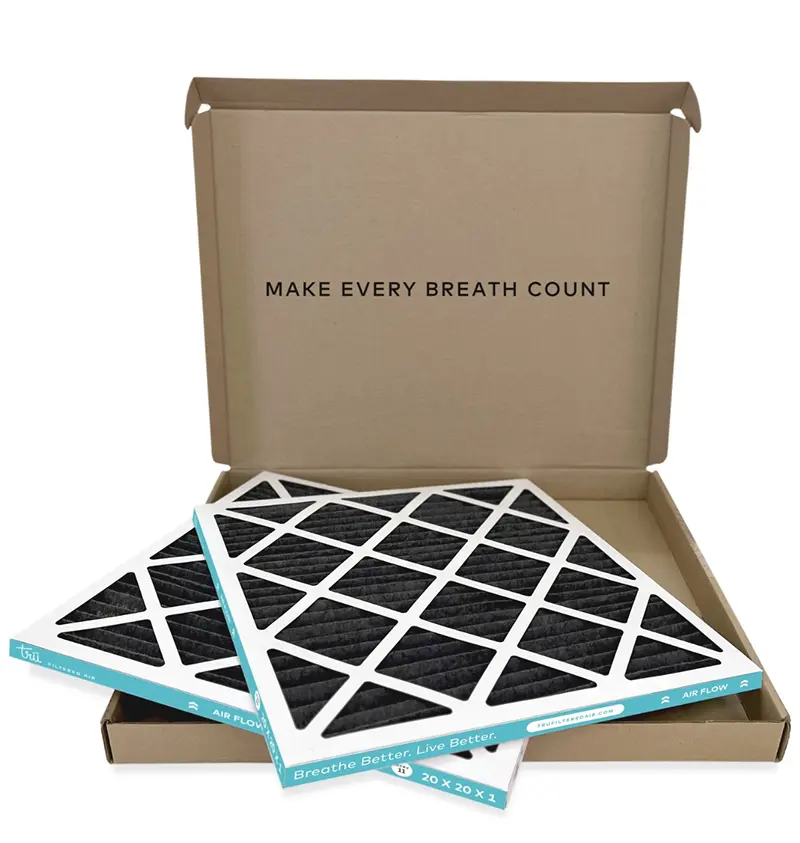
TRU pairs a carbon-backed layer with MERV 11 particle media. The construction combines particle filtration with carbon intended to help adsorb certain gases and odors. It does not mean the filter removes all VOCs, neutralizes every smell, or guarantees the air in every room. Performance can vary with pollutant type, concentration, carbon quantity, system runtime, airflow, fit, and filter condition. Those limits make it possible to compare the actual product rather than a blanket clean-air promise.
How to compare carbon claims
Look beyond a black-colored layer or the word “carbon.” Ask what the media is, how much is used, which pollutants any test covered, how the test was conducted and whether the claim reflects an initial laboratory result or performance over time. Be cautious when one result is stretched across an entire class of gases. Also verify that the filter fits the system and that its particle rating and airflow characteristics are appropriate. Carbon is one component of a filter decision, not a substitute for compatibility.
Use source control first
If a product, activity or building problem is generating a gas or odor, reducing that source and ventilating appropriately are usually more direct responses. Use a range hood that exhausts outdoors while cooking when available. Follow labels on cleaning and hobby products. Store strong-emitting materials as directed. Repair moisture problems. Bring in outdoor air only when conditions make that sensible. Filtration can supplement those actions, but no carbon-backed return filter should be positioned as permission to keep generating a pollutant indoors.
A proof standard worth expecting
A useful product page should show the filter construction, identify the particle rating, describe the carbon layer in bounded language, and link any quantified result to a method a buyer can inspect. It should also explain that HVAC filtration operates only when the system moves air. Without product-specific gas-removal testing, “helps with certain gases and odors” is the appropriate level of claim. The actual comparison is then clear: combined media, known limitations, and a simpler replacement routine.
Read the cited guidance.
U.S. EPA: Guide to Air Cleaners in the Home ↗Educational content only. Indoor-air conditions, HVAC systems, and individual circumstances vary.