MERV 11, Explained Without the Jargon
What the number measures, what it leaves out, and the questions to ask before putting any higher-rated filter in your system.
MERV is a standardized way to compare how filters remove particles of different sizes in defined test conditions. MERV 11 identifies a level of particle-filtration efficiency; it is not a score for gases, odors, fit, airflow, health outcomes or whole-home air quality. The responsible choice is the highest efficiency the specific HVAC system can accommodate.
MERV as a particle rating, not a whole-home air-quality score.
The exact size and highest efficiency the system can accommodate.
Published construction and airflow information for the specific filter.
What the letters and number tell you
MERV stands for Minimum Efficiency Reporting Value. It comes from a consensus test method used to compare particle filters. In general, a higher MERV rating indicates greater removal efficiency for most particle sizes tested. That makes MERV more useful than vague labels such as “premium” or “high performance.” It still describes performance under test conditions, not a promise about the air in every room. The installed result also depends on the filter’s fit, the HVAC system, how often the fan runs and what pollutants are present.
What MERV does not measure
MERV is a particle rating. It does not tell you how well a filter addresses gases or odors, how much activated carbon it contains, how long that carbon may remain effective, or whether air is leaking around the frame. It is not a medical certification and does not prove that a product prevents illness. It also is not a complete airflow specification. Two filters with the same MERV rating can differ in construction and pressure drop, so a number on the package should begin the evaluation, not end it.
Where MERV 11 fits
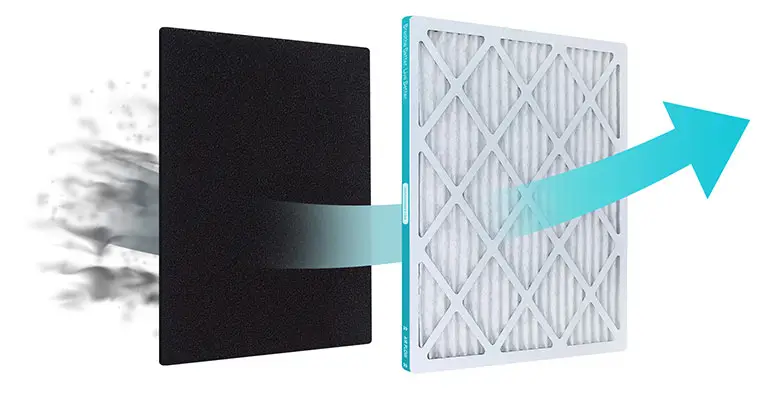
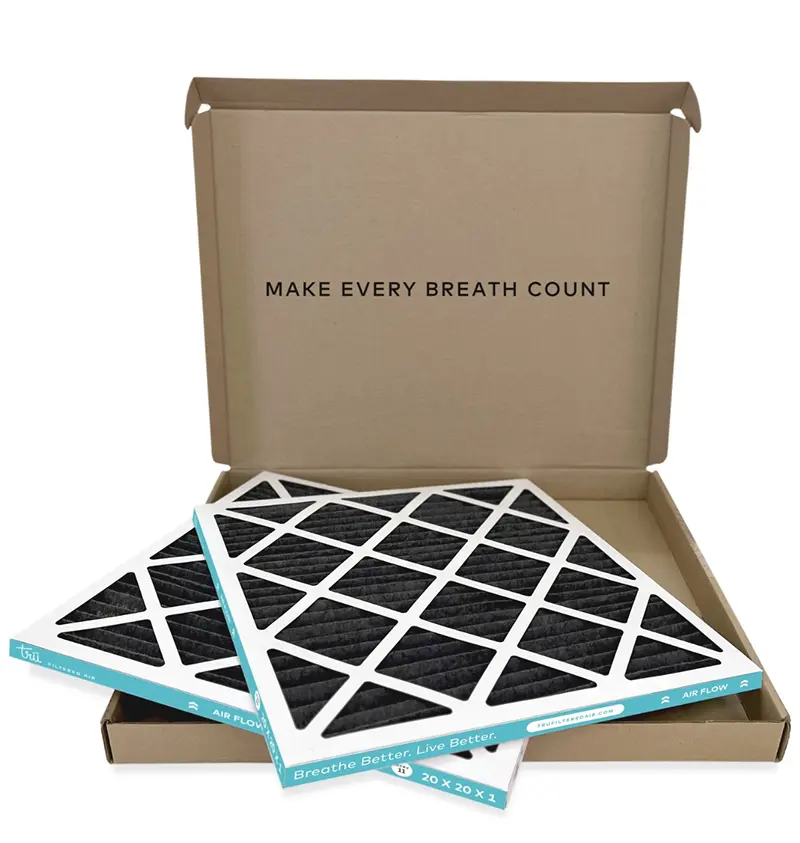
A MERV 11 filter is designed to capture more of certain particles than common lower-rated filters under the MERV test. TRU uses MERV 11 media with a carbon-backed layer. That is a construction statement, not evidence that MERV 11 is the best choice for every system or objective. Homeowners comparing options should separate three questions: What particle efficiency do I want? What can this system accommodate? What other features, such as carbon backing, delivery or subscription control, matter to the experience? Keeping those questions separate prevents convenience claims from being mistaken for filtration claims.
EPA guidance sets a higher target
EPA’s current consumer guide recommends selecting a furnace or HVAC filter rated at least MERV 13, or as high as the system’s fan and filter slot can accommodate. That guidance should be stated plainly. A MERV 11 product should not be presented as equivalent to MERV 13. Some systems may support a higher-rated filter; others may require professional evaluation or modification. If reducing smaller particles is the primary goal and the system supports MERV 13, the homeowner should weigh that option rather than choosing solely from a brand headline.
Compatibility includes airflow
The safest shorthand is not “higher is always better.” It is “use the highest efficiency your system can accommodate.” Filter dimensions, media area, design, loading and system characteristics can all affect airflow. MERV by itself does not reveal the pressure drop of a specific filter. Consult the equipment manual and any product-specific airflow or pressure-drop information that is available. If the fan, filter slot or recommendation is unclear, or if the system behaves differently after a change, ask a qualified HVAC technician.
Fit and condition can undo a good choice
A filter that is the wrong size can leave gaps or require bending and crushing to fit. EPA advises a snug fit so air does not leak around the filter. Orientation matters too: follow the airflow arrow and the system’s instructions. Then inspect the filter over time. A dirty, overloaded filter will not work well and may affect system operation. Replacement timing should follow manufacturer guidance and respond to actual conditions, not a universal date printed in an advertisement.
A better seven-step decision
Read the old filter’s exact dimensions. Check the equipment guidance. Decide which particle-filtration goal matters. Identify the highest rating the system can support. Compare product-specific construction and airflow information. Install the filter snugly in the correct direction. Finally, inspect and adjust the replacement cadence. That sequence is less dramatic than buying the biggest number on the shelf, but it is far more defensible, and much more likely to produce a routine the home can maintain.
Read the cited guidance.
U.S. EPA: Guide to Air Cleaners in the Home ↗Educational content only. Indoor-air conditions, HVAC systems, and individual circumstances vary.