
How Often Should You Change an Air Filter in Arizona?
Arizona air does not follow a single 90-day calendar. The responsible answer is to inspect, observe, and adjust to the home and the season.
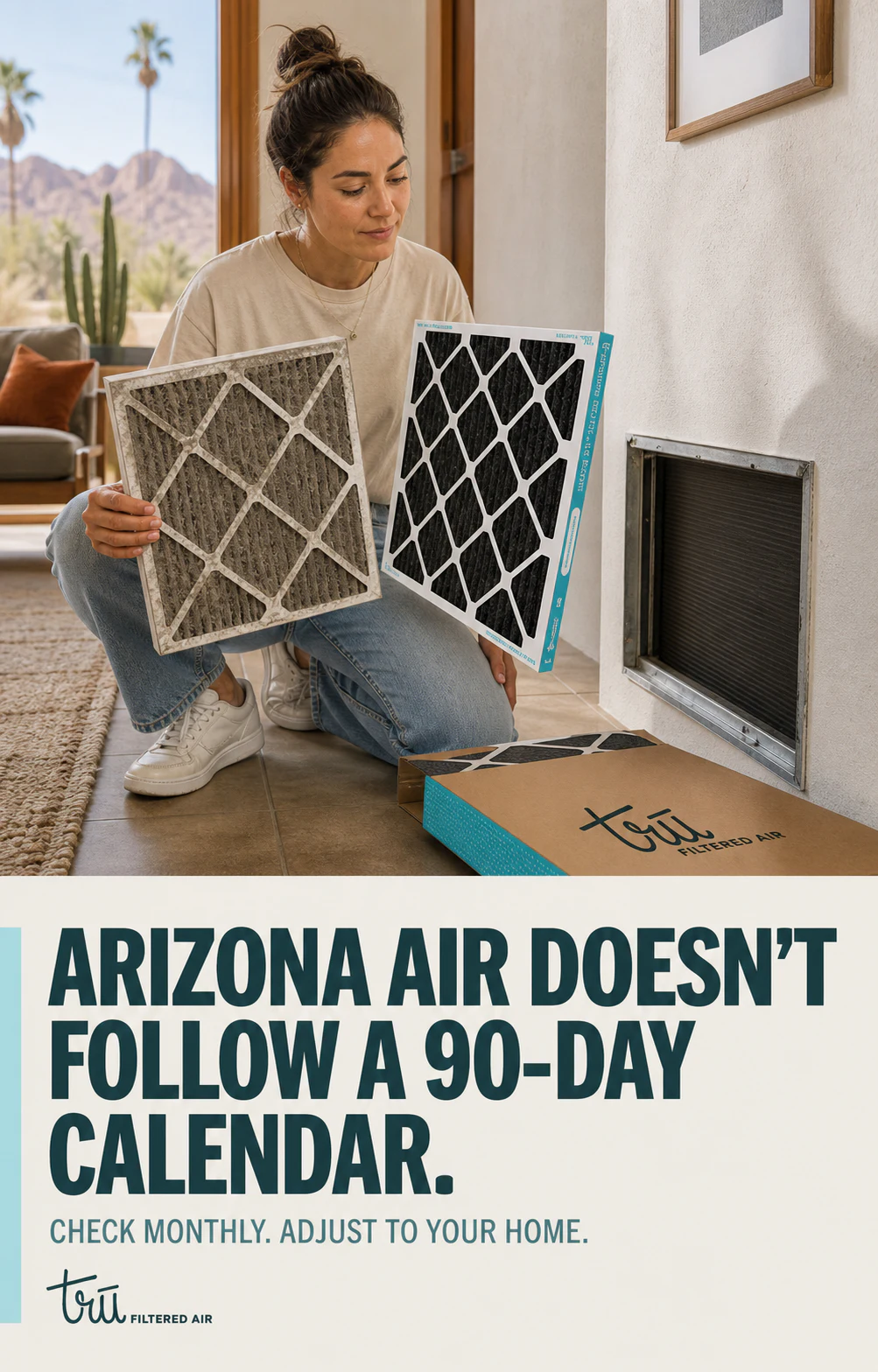
There is no evidence-based replacement interval that fits every Arizona home. Inspect the filter monthly, follow product and HVAC-system instructions, replace a dirty or overloaded filter within that guidance, and inspect sooner after unusual dust, smoke, construction, or heavy system runtime.
Inspect monthly; no single interval fits every Arizona home.
Dust, smoke, construction, and heavy runtime are reasons to inspect sooner.
Use ADEQ or AirNow for outdoor context and require human approval for cadence changes.
The short answer
Start with the HVAC equipment and filter manufacturer’s instructions. Inspect the filter monthly while learning the home’s pattern. Replace it when it is dirty or overloaded and stay within the applicable guidance. If airflow, compatibility, or equipment behavior is unclear, consult a qualified HVAC professional.
That answer is less dramatic than a universal “every 30 days” or “every 90 days,” but it is more useful. Arizona includes different elevations, climates, building types, household conditions, and HVAC runtimes. A fixed statewide interval ignores all of them.
Why Arizona conditions can change the pattern
Lower-desert homes can experience long cooling seasons and substantial system runtime. Outdoor dust, nearby construction, landscaping, open doors, pets, occupancy, and the tightness of the building envelope can influence what enters and what eventually reaches the return.
The Southwest monsoon is officially defined from June 15 through September 30. The National Weather Service notes that dust storms are more common during parts of the monsoon in affected areas. That does not mean every home receives the same exposure or that every storm requires an immediate replacement. It means an unusual event is a sensible reason to inspect sooner.
Use outdoor-air information
Arizona Department of Environmental Quality forecasts and AirNow can help households understand current particulate and smoke conditions. During wildfire smoke or a major dust event, closing doors and windows may be more appropriate than bringing outdoor air inside. EPA smoke guidance also emphasizes keeping filters clean and inspecting them frequently.
Outdoor data does not reveal the condition of a particular filter. It provides context for a decision: poor outdoor air, visible dust intrusion, or a long high-runtime period may justify an earlier check. The removed filter and the system guidance still matter.
What to look for during inspection
Turn the system off and follow equipment safety instructions. Check the filter for visible loading, damage, moisture, deformation, gaps around the frame, and the correct airflow direction. Confirm that the dimensions match the slot. A filter that bows, rattles, or leaves bypass gaps needs attention beyond a new calendar reminder.
Color alone is not a precise performance measurement. Some captured material is dark and some is not. A clean-looking surface does not prove that every part of the system is performing correctly. Repeated inspection, equipment behavior, and written guidance provide a better decision than a single photograph.
Create a household photo log
Record the installation date and take a photograph at each monthly inspection under similar lighting. Note system runtime patterns and unusual events such as remodeling, a major dust storm, wildfire smoke, a long trip, or a new pet. Over several cycles, the household can see whether the selected cadence routinely arrives too early, too late, or near a useful inspection point.
This is exactly the kind of context a future TRU account could organize. The system could suggest an earlier check during a season with heavier loading, but the customer should approve the new cadence. No silent schedule change should be treated as “learning.”
When the filter is not the whole problem
Persistent odors, visible mold, water damage, combustion concerns, carbon-monoxide alarms, unusual equipment noise, icing, or severely reduced airflow require a different response. A faster filter-delivery schedule cannot correct a hazardous source or an HVAC fault.
Use carbon-monoxide alarms as directed. Address moisture and active sources. Seek qualified remediation, building, or HVAC help when the condition is outside routine filter maintenance. Honest content should help the reader recognize those boundaries.
Turn the pattern into a convenient cadence
Once the household has a reasonable starting interval, a TRU delivery can place the correct size at the door before the intended change. The arrival becomes the visible cue to inspect. If the removed filter indicates the cadence should change, the account should make that adjustment simple.
The best Arizona filter schedule is not a statewide number. It is a repeatable household loop: follow equipment guidance, inspect monthly, respond to unusual conditions, record what the filter shows, and keep the next reminder under the customer’s control.
One approved answer becomes seven connected assets.
Arizona calendar static
Monsoon inspection carousel
Local-search FAQ
Seasonal subscriber email
Read the evidence behind the draft.
01National Weather Service · Arizona monsoon safety↗02Arizona DEQ · Air-quality and dust forecasts↗03Arizona DEQ · Wildfire FAQs↗04U.S. EPA · Reduce your wildfire-smoke exposure↗05U.S. EPA · Indoor particulate sources↗06U.S. Department of Energy · Monthly filter-check guidance↗Claim state: Green when inspection after an event is clearly labeled practical inference
Educational prototype only. Indoor-air conditions, HVAC systems, products, and individual circumstances vary. Product-specific claims require current TRU substantiation and owner approval.