
You Believe in Filtered Water. Why Not Filtered Air?
A memorable analogy can open the door to Air Wellness, as long as the brand is equally clear about where the comparison stops.
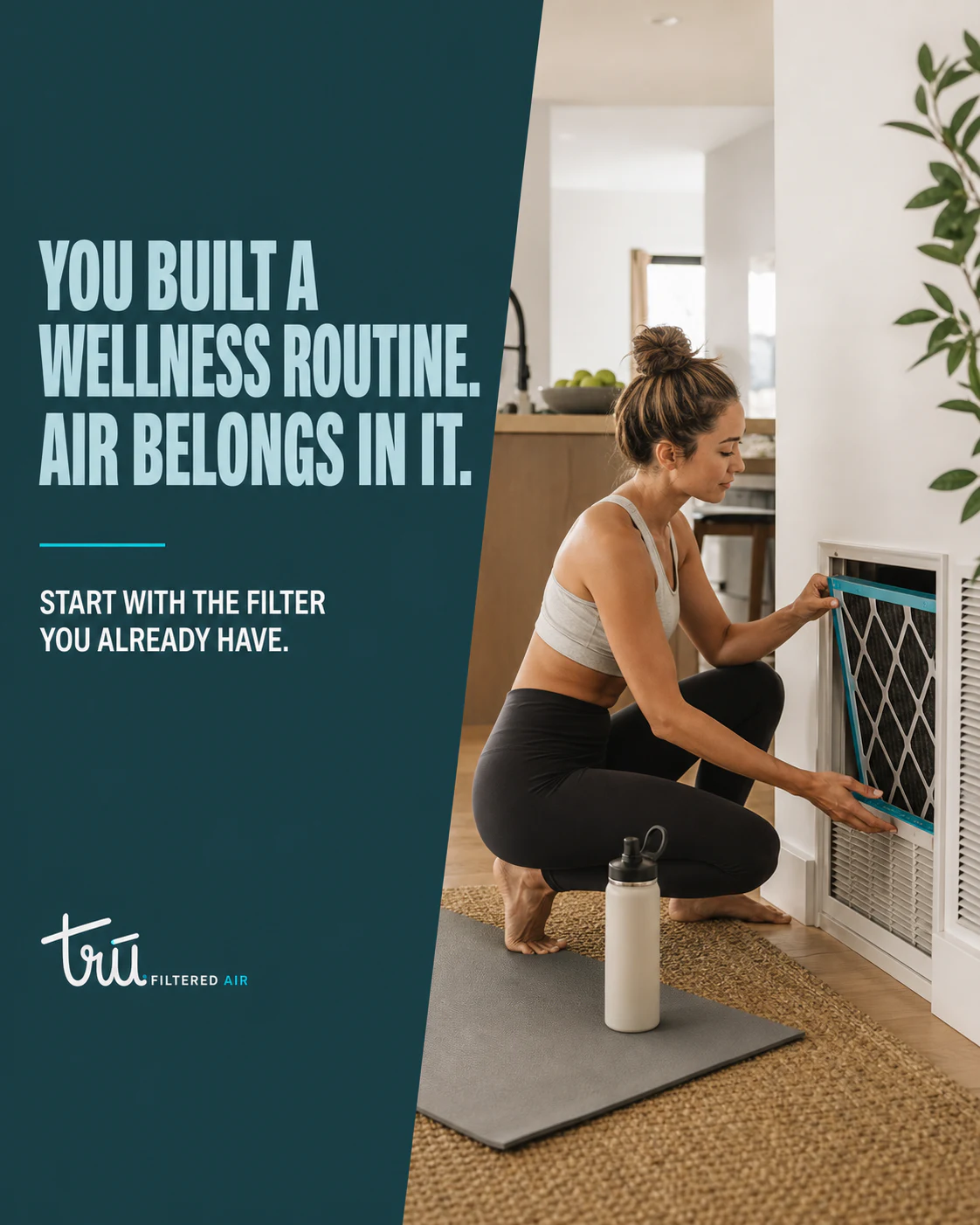
Filtered water is a useful analogy because it makes an invisible everyday input feel worth examining. Air is more complex. A central HVAC filter handles only the air that reaches the running system, and a complete indoor-air routine also considers pollution sources and ventilation. TRU can make compatible filter replacement easier to repeat without pretending one filter creates perfect air.
Air Wellness is TRU’s practical framework, not a medical classification.
Source control, context-aware ventilation, and compatible filtration work together.
The subscription can remove memory and store-run friction without claiming perfect air.
Why the water comparison works
Most people do not need a chemistry lesson before deciding that drinking water deserves attention. The idea is already familiar: an invisible everyday input can vary, treatment methods have limits, and the equipment has to be maintained. “You believe in filtered water. Why not filtered air?” transfers that instinct to a part of the home that is usually hidden behind a return grille.
The comparison is powerful because it creates curiosity, not because air and water systems are technically equivalent. A strong TRU article should say that plainly. Water reaches a defined tap through plumbing. Indoor air is continually affected by people, cooking, cleaning, outdoor conditions, furnishings, moisture, pets, combustion, and the way the building moves air. The analogy is an invitation to pay attention, not evidence that an HVAC filter produces a bottled-water-style result.
Why indoor air deserves a routine
The U.S. Environmental Protection Agency says people spend about 90% of their time indoors on average. That does not mean every indoor space is unsafe. It means the indoor environment occupies enough of daily life to deserve the same practical attention people already give to food, movement, sleep, and water.
Conditions can vary from one home to another, from room to room, and throughout the day. Cooking can add particles. Cleaning and hobby products can release gases. Outdoor smoke or dust can enter. Water intrusion can create a moisture problem that no filter should be expected to solve. A useful Air Wellness routine begins with the real home rather than a universal fear-based promise.
The three-part Air Wellness framework
TRU can define Air Wellness as a practical household framework built around three complementary actions: reduce pollution at its source, ventilate with suitable outdoor air when conditions allow, and use filtration that fits the home and HVAC system. This tracks the EPA’s basic indoor-air strategy while giving the brand an accessible way to organize it.
Source control often deserves the first look. Use an exhaust hood that vents outdoors while cooking when available. Keep smoking outdoors. Follow labels on paints, solvents, fragrances, and cleaning products. Correct a water leak instead of expecting filtration to solve mold or moisture. Ventilation can help dilute indoor pollutants, but opening a window is not responsible advice during wildfire smoke, a severe dust event, or other poor outdoor-air conditions. Context matters.
What the central filter contributes
A central HVAC filter can capture a portion of airborne particles in the size ranges it is rated for, but only when the system is moving air and that air reaches the filter. It cannot capture particles that settle before reaching the return. It cannot correct a pollution source, remove carbon monoxide, fix radon, remediate mold, or guarantee equal conditions in every room.
Fit is part of performance. Air that travels around a poorly fitted frame is not passing through the media. The exact dimensions, airflow resistance, system runtime, filter condition, and equipment compatibility all matter in the real home. That is why Air Wellness should be framed as a repeatable system, not a miracle product claim.
Choose for the system, not the slogan
EPA consumer guidance recommends MERV 13 or the highest rating the system can accommodate. TRU currently markets carbon-backed MERV 11 filters. Those two facts can coexist honestly: MERV 11 is a defined particle-efficiency level, while the appropriate filter for a particular home still depends on the equipment, filter slot, airflow, and available product data.
A homeowner should confirm the exact size, check the equipment or manufacturer guidance, and seek help from a qualified HVAC professional when the compatible rating is unclear. Look for product-specific test documentation and airflow information rather than relying on undefined “best” or “superior” language.
Where TRU creates practical value
For a home that already uses a replaceable central filter, the recurring task exists whether the replacement comes from TRU, a home-improvement store, or another supplier. TRU can create value by making the right size easier to remember, delivering on the cadence the household chooses, and giving the customer clear control to skip, pause, or change that cadence.
The strongest promise is not perfect air. It is a better-maintained filter habit with fewer memory gaps and store runs. That promise is specific, useful, and believable. It also gives TRU a natural bridge into broader education about source control, ventilation, room-specific needs, and honest product limits.
A five-minute Air Wellness check
Look at the current filter. Confirm the printed dimensions, airflow direction, installation date, visible fit, and condition. Check when the HVAC system is actually running. Identify one avoidable indoor source, such as an unvented cooking event, an indoor candle, or an improperly stored product. Check current outdoor-air conditions before deciding whether window ventilation makes sense.
Then record the filter size and a reasonable inspection date. That small loop is the habit TRU can make easier: know what the home uses, keep the replacement within reach, inspect what comes out, and adjust the next reminder to what the household actually observed.
One approved answer becomes seven connected assets.
8-slide category carousel
Filtered-water static provocation
Founder talking point
Welcome-email education block
Read the evidence behind the draft.
01U.S. EPA · Guide to Air Cleaners in the Home↗02U.S. EPA · Care for Your Air↗03U.S. EPA · Indoor Air Quality↗Claim state: Green with sourced 90% qualifier and explicit filtration limits
Educational prototype only. Indoor-air conditions, HVAC systems, products, and individual circumstances vary. Product-specific claims require current TRU substantiation and owner approval.