
Healthy Habits on Repeat: A Filter-Replacement Routine That Sticks
The strongest subscription promise is not a sensor or a universal schedule. It is a visible reminder, the right size within reach, and a cadence the household can change.
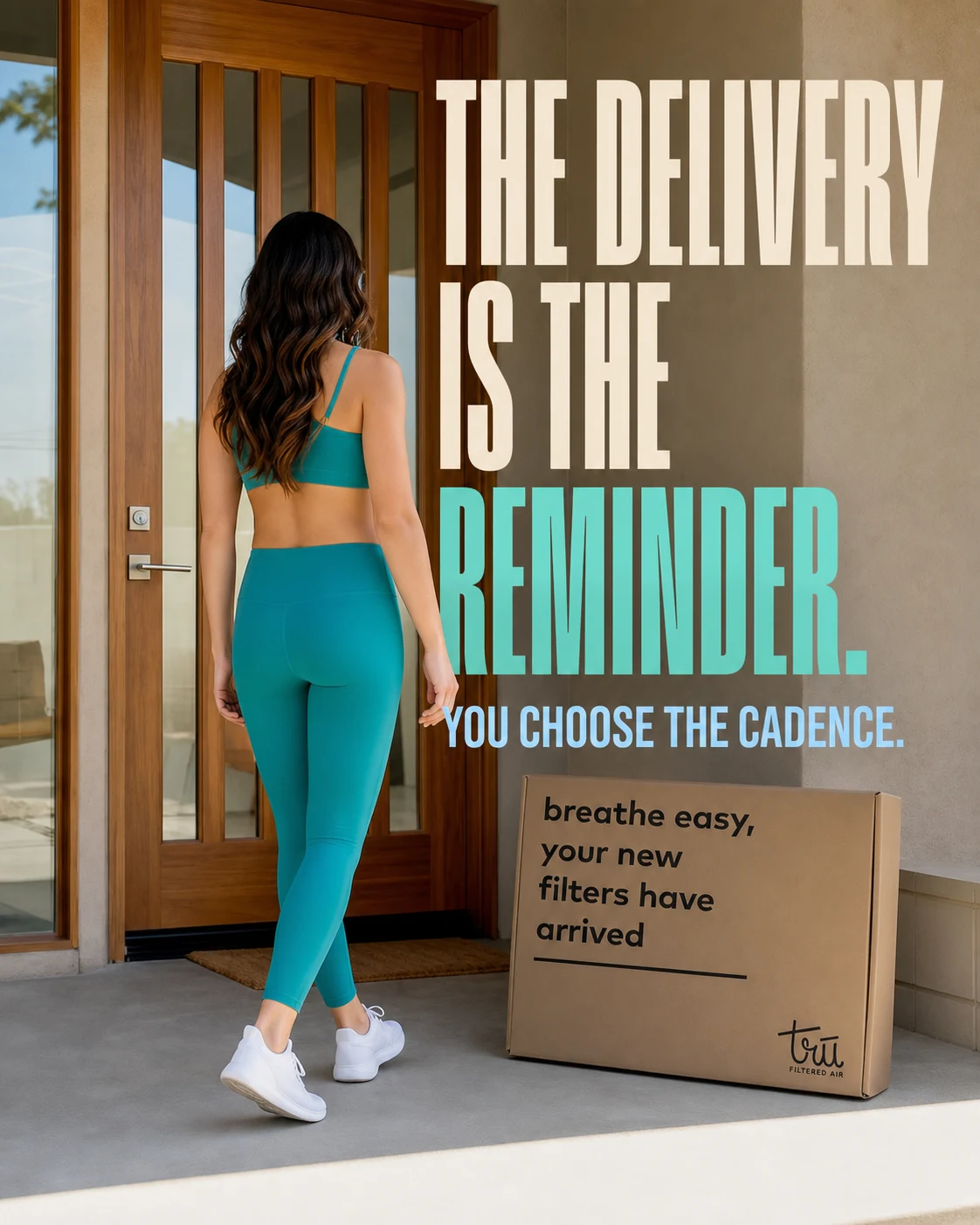
Filters require regular inspection and replacement, but no single interval fits every home. A TRU delivery can serve as a visible reminder on a cadence the customer chooses. The household should still follow product and equipment guidance, inspect what comes out, and adjust future timing to actual conditions.
Delivery is a reminder, not a filter-condition sensor.
Start with written equipment guidance and a complete household filter inventory.
Inspect, record, and keep future deliveries editable.
Why filter replacement is easy to forget
A central filter is out of sight, has no satisfying daily interface, and usually becomes urgent only after the household notices it has been ignored. The task also contains small points of friction: remembering the dimensions, finding the right product, making a store run, recording the date, and deciding when to do it again.
A useful subscription removes those frictions without pretending to know more than it does. The delivery schedule is a customer-selected reminder, not a sensor reading from the installed filter or a precise prediction of the day replacement becomes necessary.
Why no calendar interval fits every home
Filters load as the system moves air and airborne material reaches the media. System runtime, climate, household activity, pets, occupancy, renovation work, outdoor smoke, dust events, fit, and filter construction can all influence what the homeowner sees at inspection.
A filter in a heavily used Arizona cooling system may not resemble the same product in a mild period with less runtime. That does not create a universal “Arizona rule” or “pet-home rule.” It creates a reason to inspect, learn, and adjust.
Build the household inventory first
Before setting a cadence, record every filter location, printed nominal size, quantity, depth, airflow direction, and any equipment guidance. Multi-return homes may use different dimensions. A delivery that remembers only one of them does not remove the full household task.
A production TRU system can store that inventory visibly and let the customer update it. The content engine can also teach the process with a size-check carousel, an entry-vent video, a printable home map, and support scripts that all share the same approved language.
Choose a starting rhythm
Begin with the equipment and filter manufacturer’s instructions. If compatibility or airflow is uncertain, ask a qualified HVAC professional. Set an initial inspection date before the expected replacement date rather than waiting for an obvious performance problem.
Write the installation date on the frame or save it in the household record. Inspect while the system is off and according to the equipment’s safety guidance. Look for visible loading, damage, gaps, and an incorrect installation direction. Color alone is not a laboratory measurement, but repeated observations can help a household understand whether its starting cadence is reasonable.
Let the delivery create the cue
A box at the door is a useful physical trigger: the replacement is present, the size search is already resolved, and the task becomes hard to ignore. That is the credible version of “healthy habits on repeat.” The delivery is a reminder attached to a chosen plan.
The customer should be able to see the next shipment, skip it, move it, pause it, or change quantities. A system that learns the household should make control easier, not turn an initial estimate into a permanent schedule.
Inspect, record, and adjust
Take a quick photo of the removed filter, record the date, and note any unusual event: construction, a dust storm, wildfire smoke, a long absence, a pet change, or a season with heavy HVAC runtime. Over several cycles, the household develops a more useful record than a generic internet interval.
In the future connected product, those observations could generate a recommendation such as “inspect two weeks earlier next cycle.” The system should still ask the customer to confirm the change. Evidence becomes a suggestion; the person remains the decision-maker.
The honest subscription promise
TRU can confidently promise a simpler replacement routine: the selected size delivered on the cadence the customer chooses, with the arrival serving as the reminder. It should avoid “delivered automatically on the precise day the filter needs changing” unless a validated sensor and decision system actually exist.
That honest distinction strengthens the brand. The engine is not selling blind autopilot. It is building a low-friction loop that makes responsible home care easier to repeat, and easier to adapt as the home changes.
One approved answer becomes seven connected assets.
Delivery-is-reminder static
7-step replacement carousel
Subscriber onboarding email
Account-control FAQ
Read the evidence behind the draft.
01U.S. EPA · Guide to Air Cleaners in the Home↗02U.S. EPA · What Is a MERV Rating?↗03U.S. Department of Energy · Check filters monthly↗04TRU · Current subscription representations↗Claim state: Green when cadence is described as customer-selected and editable
Educational prototype only. Indoor-air conditions, HVAC systems, products, and individual circumstances vary. Product-specific claims require current TRU substantiation and owner approval.