
Carbon-Backed MERV 11: What Each Layer Is Designed to Do
MERV describes particle performance. Carbon addresses a different category. A credible product story starts by keeping those jobs separate.
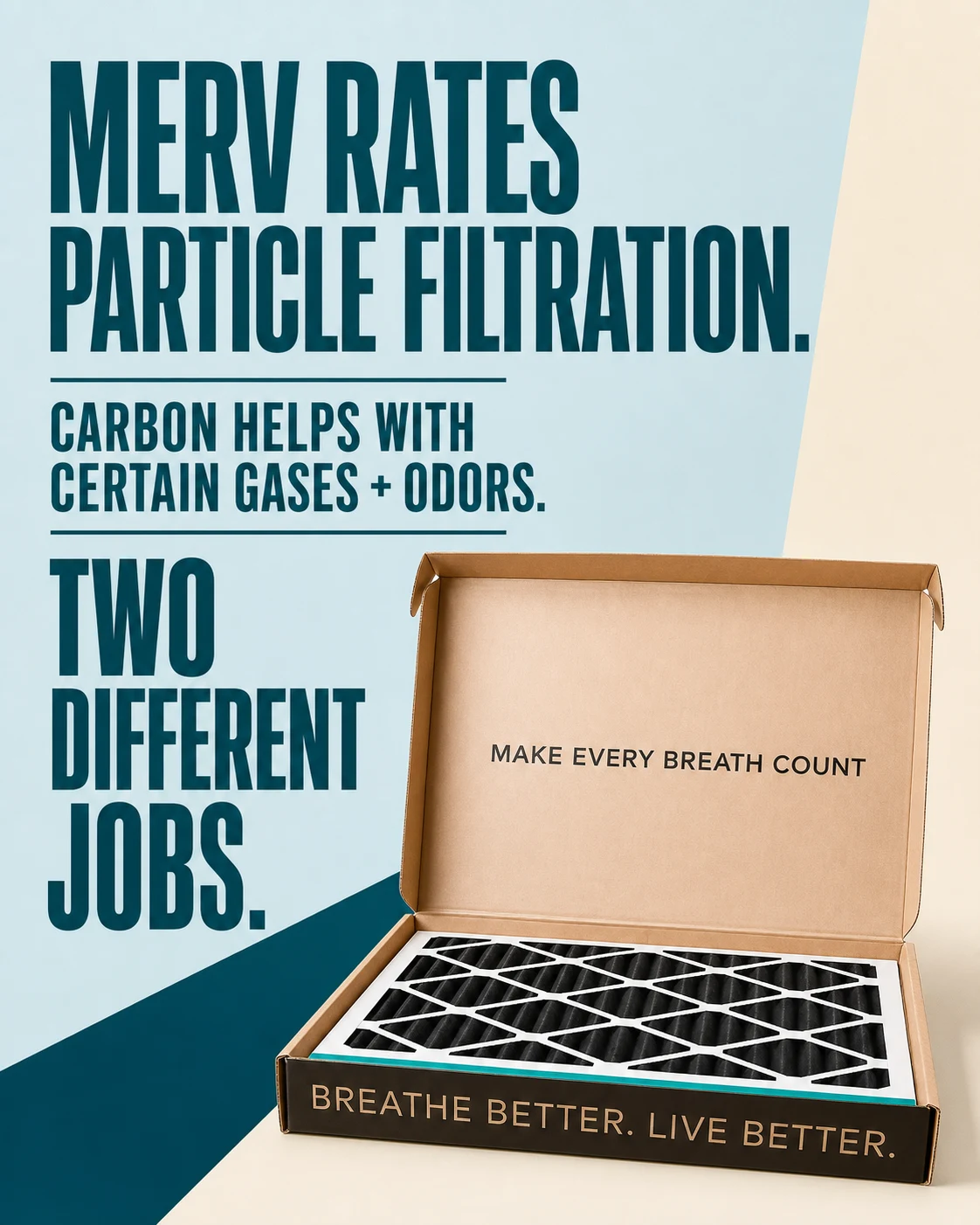
MERV is a laboratory-derived rating for particle filtration. A carbon backing is intended to adsorb certain gases and odor-causing compounds. Neither statement means a filter removes everything. Product-specific airflow, pressure-drop, carbon-loading, and gas-removal evidence should determine how far TRU’s claims can go.
MERV rates particle filtration; it does not rate gases or VOCs.
Carbon effectiveness depends on pollutant, quantity, contact time, airflow, and construction.
TRU should publish product-specific test and pressure-drop evidence before superiority claims.
Start by separating particles from gases
Dust, pollen, and many smoke components are particles. Odor-causing compounds and volatile organic compounds are gases. They behave differently, so the materials used to address them perform different jobs. MERV describes particle-filter performance. It does not rate gas or odor removal.
Activated carbon is a porous sorbent. Certain molecules can adhere to its large internal surface as air passes over it. The practical result depends on the specific compound, the quantity and form of carbon, contact time, airflow, loading, humidity, and product construction. A black layer is not automatically proof of broad VOC removal.
What a MERV rating actually tells you
MERV stands for Minimum Efficiency Reporting Value. The rating comes from the ASHRAE 52.2 test method and describes a filter’s measured efficiency across particle-size groups between 0.3 and 10 microns. Under the published table, MERV 11 corresponds to at least 20% efficiency in the 0.3-1 micron group, 65% in the 1-3 micron group, and 85% in the 3-10 micron group.
Those are standardized test criteria, not guaranteed whole-home pollutant-removal percentages. Field performance can change with filter fit, airflow, system runtime, loading, bypass, and the behavior of particles inside a particular building. “MERV 11” is useful product information. “Removes 85% of everything in your home” would not be a fair translation.
What activated carbon is intended to do
Activated carbon is used in air-cleaning products to adsorb certain gases and odors. EPA guidance notes that gas-removal effectiveness requires an appropriate sorbent and that the amount of material matters. A thin carbon backing in a residential HVAC filter is not equivalent to a deep-bed gas-removal system.
That distinction should shape TRU’s copy. “The carbon backing is designed to help adsorb certain gases and odors” is bounded and understandable. “Eliminates VOCs and odors” is far broader. Without a disclosed product-specific method and result, the second statement outruns the evidence.
Why product evidence matters
A claim-safe product card should connect each statement to a file. The MERV claim should link to current ASHRAE 52.2 documentation for the relevant filter construction and sizes. Airflow language should link to pressure-drop curves at stated face velocities. Carbon claims should identify the material, loading, test compound, method, duration, and conditions.
Different depths and sizes may not behave identically. If one test was conducted on one construction, the engine should not silently apply it to every SKU. That is exactly where a Claim Ledger becomes valuable: it records the statement, exact scope, supporting file, limitations, owner, approval date, and review date.
MERV 11 and system compatibility
EPA’s general homeowner guidance recommends MERV 13 or the highest rating the system can accommodate. A higher rating can provide greater particle efficiency, but the home’s equipment and filter configuration still matter. TRU should not position MERV 11 as universally best without comparative airflow and pressure-drop evidence.
The honest consumer instruction is to confirm the correct dimensions and the highest compatible efficiency for the system. When that is unclear, a qualified HVAC professional can help. Compatibility language is not a concession. It signals that TRU cares about the whole home rather than winning a number contest.
How to compare carbon-backed filters
Look for the particle rating, exact dimensions, depth, construction, and available airflow information. Ask how the carbon is applied and whether quantified gas or odor claims link to a method. Check whether performance claims apply to the exact SKU or merely to a component used in a different test.
Then evaluate the service around the product: clear size selection, cadence control, shipping, replacement guidance, and an accessible source file. The best product story does not hide its limits. It helps a buyer understand what each layer is designed to do and what must still be addressed elsewhere.
The TRU difference worth proving
TRU’s carbon-backed MERV 11 construction is visually distinctive and easy to teach. The turquoise edge, black carbon surface, white lattice, and pleated media create a recognizable product language. The creative engine can turn that construction into macros, diagrams, before-and-after maintenance stories, and FAQs without inventing a result.
The next step is evidence depth. With current test files and clearly scoped claims, TRU can move from attractive product language to a transparent proof system. Until then, the strongest message remains the most accurate one: particle filtration and carbon play different roles, and real-world results depend on the product, pollutant, system, and conditions.
One approved answer becomes seven connected assets.
Two-layers product macro
MERV explainer carousel
Sales FAQ
Claim-safe comparison card
Read the evidence behind the draft.
01U.S. EPA · What Is a MERV Rating?↗02ASHRAE Handbook · MERV particle-size efficiency table↗03ASHRAE · Laboratory testing is not field performance↗04U.S. EPA · Guide to Air Cleaners in the Home↗Claim state: Amber until TRU supplies product-specific test and airflow files
Educational prototype only. Indoor-air conditions, HVAC systems, products, and individual circumstances vary. Product-specific claims require current TRU substantiation and owner approval.