
What Your HVAC Filter Can and Cannot Do
A better filter can be useful without becoming a magic wand. Clear limits make the product story more credible, not less.
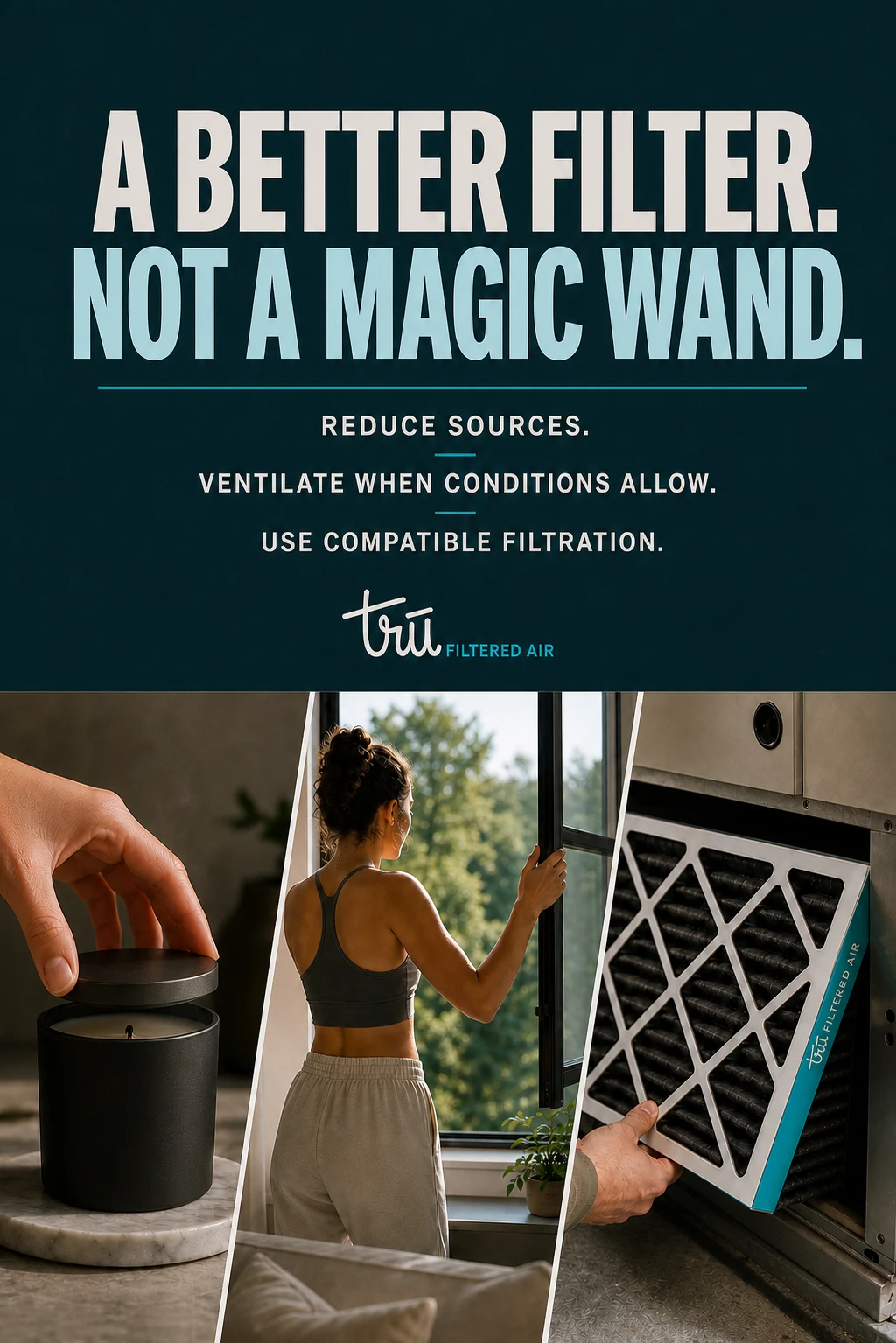
A compatible HVAC filter can capture a portion of airborne particles that reach it while the system operates. A properly designed carbon component may help with certain gases or odors. It cannot remove every pollutant, fix a source problem, replace ventilation, or guarantee a health outcome.
A central filter affects only air that reaches it while the system operates.
It cannot fix sources, remove CO or radon, remediate mold, or guarantee health outcomes.
Clear limitations create a stronger trust position and better customer support.
What a central filter can do
A central filter can capture a portion of airborne particles in the size ranges described by its rating when air moves through the system. A higher-efficiency compatible filter can contribute to lower indoor particle levels. Proper fit, installation direction, system runtime, airflow, and maintenance all influence real-world performance.
A filter also creates a useful maintenance checkpoint. The removed media shows that material reached the return and gives the household a reason to review fit, timing, and conditions. That observation is useful, but it is not a complete indoor-air-quality test.
What the MERV number cannot tell you
MERV summarizes standardized particle-efficiency criteria. It does not measure gases, odors, carbon-monoxide removal, radon, mold remediation, health outcomes, or whole-home air quality. It also does not tell a homeowner whether a specific filter will fit the slot or whether the equipment can accommodate its resistance.
Laboratory performance should not be translated into a blanket promise about every home. The system, airflow, loading, bypass, source strength, particle behavior, and room-to-room movement all matter.
What a carbon layer may contribute
Activated carbon is used to adsorb certain gases and odor-causing compounds. Its effectiveness depends on the target compound, amount and form of carbon, contact time, airflow, humidity, and filter condition. A carbon-backed residential filter generally contains far less sorbent than a dedicated deep-bed gas-removal system.
Without product-specific testing, “designed to help with certain gases and odors” is defensible. “Eliminates VOCs” or “complete odor control” is not. The presence of carbon should never be used to justify ongoing exposure to a hazardous or persistent source.
Six problems the filter cannot solve
It cannot fix a water leak or remediate active mold. It cannot remove carbon monoxide safely enough to replace alarms and appliance maintenance. It cannot remove radon. It cannot stop a candle, cleaning product, cooking event, or smoking source from emitting. It cannot guarantee every room receives the same treatment. It cannot create a health outcome such as better sleep, lower stress, heart support, immunity, or disease prevention.
Those limits do not make the filter irrelevant. They define the jobs that should be handled elsewhere and protect the brand from collapsing very different household risks into one product promise.
Why source control comes first
If a controllable activity is creating pollution indoors, reducing or removing that source is usually more direct than filtering after the fact. Use outdoor-venting exhaust while cooking when available. Keep smoking outdoors. Follow labels on household and hobby products. Address moisture. Maintain combustion appliances.
Ventilation can complement source control when outdoor conditions are suitable. During wildfire smoke, major dust, or other poor outdoor-air periods, bringing outside air in may be counterproductive. A useful Air Wellness system responds to context rather than repeating one universal instruction.
When to bring in another tool or professional
Portable air cleaners may be useful for a specific room and pollutant when properly selected. Carbon-monoxide alarms, radon testing, qualified HVAC service, building diagnostics, remediation, and medical guidance solve different problems. Persistent odors, visible mold, water damage, combustion concerns, or unexplained symptoms deserve the appropriate next step.
Questions about these conditions should be routed to reviewed help content or an appropriate professional, not answered with automatic reassurance. A community manager should see a clear escalation state before any reply is sent.
A truthful buying checklist
Confirm the exact size and depth. Identify the highest efficiency the system can accommodate. Review available pressure-drop and product-test information. Understand what MERV rates. Treat carbon as a separate material with separate evidence. Check the frame fit and installation direction. Follow product and equipment guidance. Keep replacement timing editable.
Finally, ask whether the brand makes those facts easy to inspect. A trustworthy product page shows what is known, what varies, and where evidence lives. A better filter does not need a magic-wand story. It needs a specific job, a compatible system, and a routine people can maintain.
One approved answer becomes seven connected assets.
Not-a-magic-wand static
Can / cannot carousel
Support escalation guide
Claim-safe sales enablement
Read the evidence behind the draft.
01U.S. EPA · Guide to Air Cleaners in the Home↗02U.S. EPA · Care for Your Air↗03U.S. EPA · Ozone generators sold as air cleaners↗04U.S. EPA · Carbon-monoxide guidance↗Claim state: Green and strategically valuable as a trust-building article
Educational prototype only. Indoor-air conditions, HVAC systems, products, and individual circumstances vary. Product-specific claims require current TRU substantiation and owner approval.